
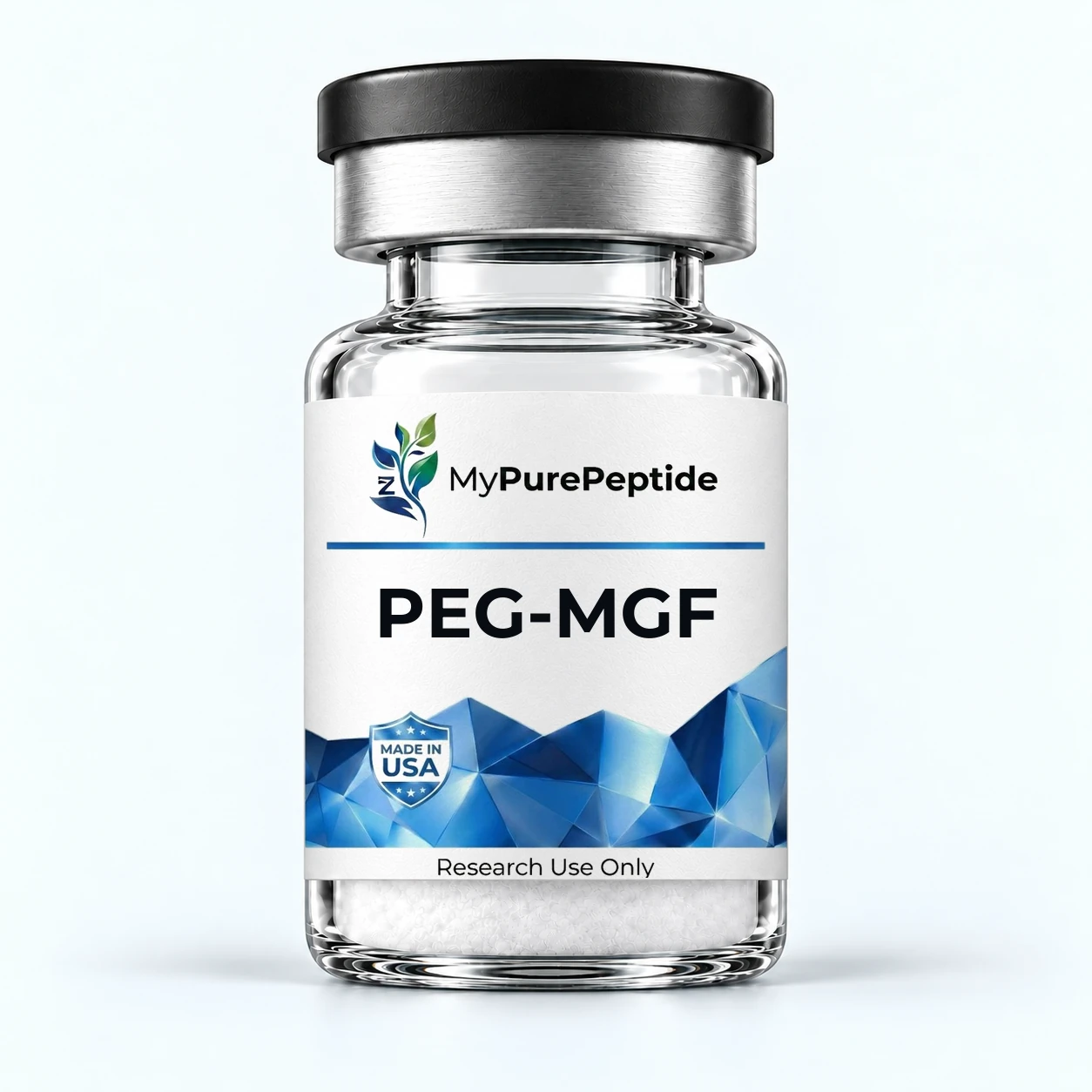
Reports & sample documentation
A report for this exact product and strength is not linked in the available documentation.
No result or sample photograph from a different product has been substituted.
Browse the COA directory- Identity
- PEG-MGF
- Classification
- PEG-conjugated MGF-related research material
- Primary study system
- Conjugate identity, size/SEC, exploratory receptor-signaling, and stability assays
- Presentation
- 2mg
- Physical form
- PEG-conjugated peptide research material
- Research designation
- PEG-MGF
PEG-conjugated research material supplied for conjugate-identity, size-exclusion, exploratory signaling, analytical-method, and stability studies.
The page is intentionally organized around compound identity, defined molecular systems, measurable laboratory readouts, and lot documentation rather than consumer outcomes.
Conjugate identity
PEG attachment changes mass, hydrodynamic behavior, chromatography, and retention, so conjugate identity should be characterized directly.
Commercial construct variability
The exact PEG size, attachment chemistry, and peptide construct can vary by source; the lot specification should control identity.
Size-based analysis
SEC, LC-MS where suitable, and complementary methods can assess conjugated, unconjugated, and aggregate-related species.
Exploratory signaling
Cell-based signaling experiments should state the receptor or pathway hypothesis being tested rather than presuming a universal mechanism for a commercial PEG-MGF material.
- 01
Conjugate characterization
Assess PEG conjugation and intact-material identity with suitable orthogonal methods.
- 02
Size-exclusion chromatography
Resolve aggregate-related, conjugated, and lower-molecular-size species where the method permits.
- 03
Exploratory signaling
Measure a prespecified receptor or phosphoprotein hypothesis in a defined cell system.
- 04
Comparative controls
Compare PEG-conjugated material with an appropriate unconjugated reference when available.
- 05
Stability studies
Track conjugate retention, deconjugation, aggregation, and related species.
Method note: Controls, concentrations, matrices, acceptance criteria, and storage conditions belong in the laboratory’s validated method. Results should be interpreted only within the specific assay system used.
- 01PEG MGF peptide literature searchPubMed · literature indexOpen literature search
- 02mechano growth factor PEGylated peptide literature searchPubMed · literature indexOpen literature search
- 03PEGylated peptide analytical SEC literature searchPubMed · literature indexOpen literature search
- 04PEG-MGF compound database searchPubChem · identity/chemistry discoveryOpen database search
These links are provided for identity, chemistry, receptor/assay context, analytical methods, or component-specific research. Search results and cited literature do not establish the performance of a commercial lot or a use recommendation.
PEG size and attachment chemistry affect molecular mass, chromatography, and other measured properties, so lot-specific identity is important.
When available, a matched unconjugated reference can help distinguish peptide-related behavior from effects of the PEG conjugate itself.
A report for this exact product and strength is not currently linked on this page. Contact support with the product name and the lot number on your vial to ask which documentation is available. Reports for other products or strengths do not verify this material.
It is a lot-specific analytical measurement reported by the testing laboratory. It should not be treated as a permanent value for every lot.
Keep unopened material sealed, dry, protected from light, and under the conditions stated on the product label or current lot documentation.
For analytical work requiring a solution, the laboratory should select the solvent, concentration, container, controls, and stability window as part of its validated method.
MyPurePeptide fulfills orders from Austin, Texas. Current processing and shipping details are published in the site shipping policy.
It is supplied for laboratory research and analytical work only and is not intended for human or veterinary use.