
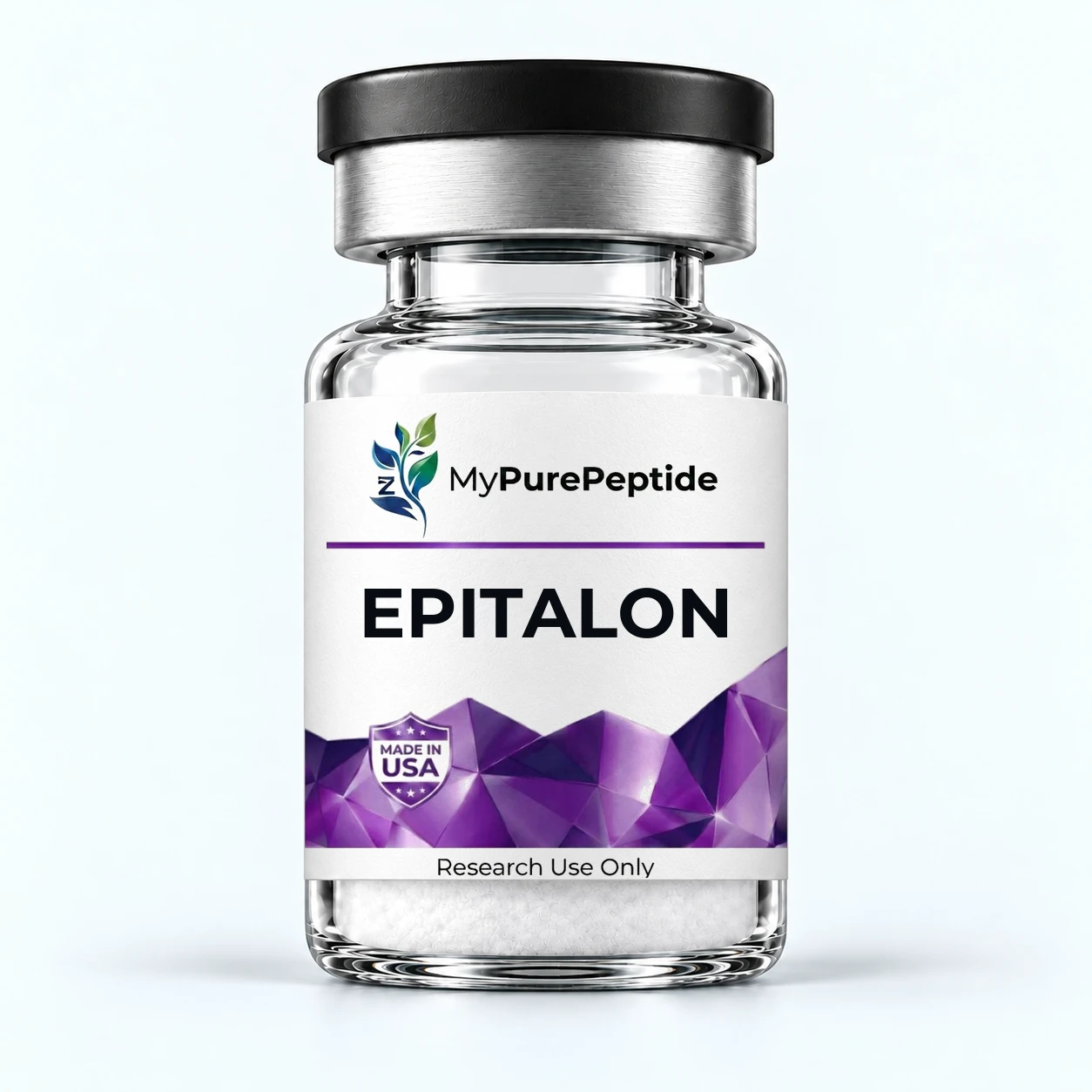
Latest Janoshik reports & sample documentation
Current product-specific documentation, with earlier reports retained below.
COA
- Mass
- 8.63mg
- Purity
- 99.447%
 Preview unavailable. Open original image.
 Preview unavailable. Open original image.
Report identifiers
- Laboratory
- Janoshik
- Task
- 136088
- Verification key
- CMIWQZ7XRKSY
- Report batch
- Not supplied in this record
- Laboratory sample label
- Epitalon 10mg
- Identity
- Epitalon / AEDG
- Classification
- Synthetic tetrapeptide research material
- Primary study system
- Peptide identity, cultured-cell transcription, enzyme-assay, and stability systems
- Presentation
- 10mg
- Physical form
- Lyophilized tetrapeptide material
- Research designation
- AEDG tetrapeptide
Synthetic tetrapeptide material supplied for peptide-identity, cultured-cell transcriptional, enzyme-assay, analytical-method, and stability studies.
The page is intentionally organized around compound identity, defined molecular systems, measurable laboratory readouts, and lot documentation rather than consumer outcomes.
Short peptide chemistry
The four-residue structure makes sequence identity, related species, and degradation patterns practical analytical targets.
Cellular transcriptional assays
Defined cultured-cell systems can be used to measure selected gene-expression changes with explicit controls and prespecified endpoints.
Enzyme-assay context
Candidate enzyme or protein-interaction assays can be run as mechanistic experiments without presenting a consumer outcome.
Method dependence
Short peptides can be sensitive to matrix, adsorption, and degradation, so assay-specific controls are important.
- 01
Peptide identity
Confirm sequence-related identity and related species with HPLC/LC-MS.
- 02
Gene-expression assays
Measure selected transcripts in a defined cultured-cell system.
- 03
Enzyme activity assays
Test a prespecified biochemical hypothesis with appropriate positive and negative controls.
- 04
Cellular localization
Use imaging or fractionation when a validated study design calls for it.
- 05
Stability characterization
Track intact tetrapeptide across laboratory-selected matrices and conditions.
Method note: Controls, concentrations, matrices, acceptance criteria, and storage conditions belong in the laboratory’s validated method. Results should be interpreted only within the specific assay system used.
- 01Epitalon AEDG peptide literature searchPubMed · literature indexOpen literature search
- 02AEDG tetrapeptide in vitro literature searchPubMed · literature indexOpen literature search
- 03Epitalon peptide analytical literature searchPubMed · literature indexOpen literature search
- 04Epitalon AEDG compound database searchPubChem · identity/chemistry discoveryOpen database search
These links are provided for identity, chemistry, receptor/assay context, analytical methods, or component-specific research. Search results and cited literature do not establish the performance of a commercial lot or a use recommendation.
AEDG is the four-residue sequence shorthand commonly associated with Epitalon in the literature.
Short peptides can produce closely related degradation or synthesis species, so orthogonal analytical confirmation is useful.
Use the documentation link on this page or the Lab Tests directory. Where a task-matched current report is shown, that record controls its stated analytical results.
It is a lot-specific analytical measurement reported by the testing laboratory. It should not be treated as a permanent value for every lot.
Keep unopened material sealed, dry, protected from light, and under the conditions stated on the product label or current lot documentation.
Store at 2–8°C after reconstitution for short-term laboratory handling, unless the product label or lot documentation states otherwise. Longer-term stability depends on solvent, concentration, container, and protocol.
MyPurePeptide fulfills orders from Austin, Texas. Current processing and shipping details are published in the site shipping policy.
It is supplied for laboratory research and analytical work only and is not intended for human or veterinary use.