Reports & sample documentation
A report for this exact product and strength is not linked in the available documentation.
No result or sample photograph from a different product has been substituted.
Browse the COA directory- Compound
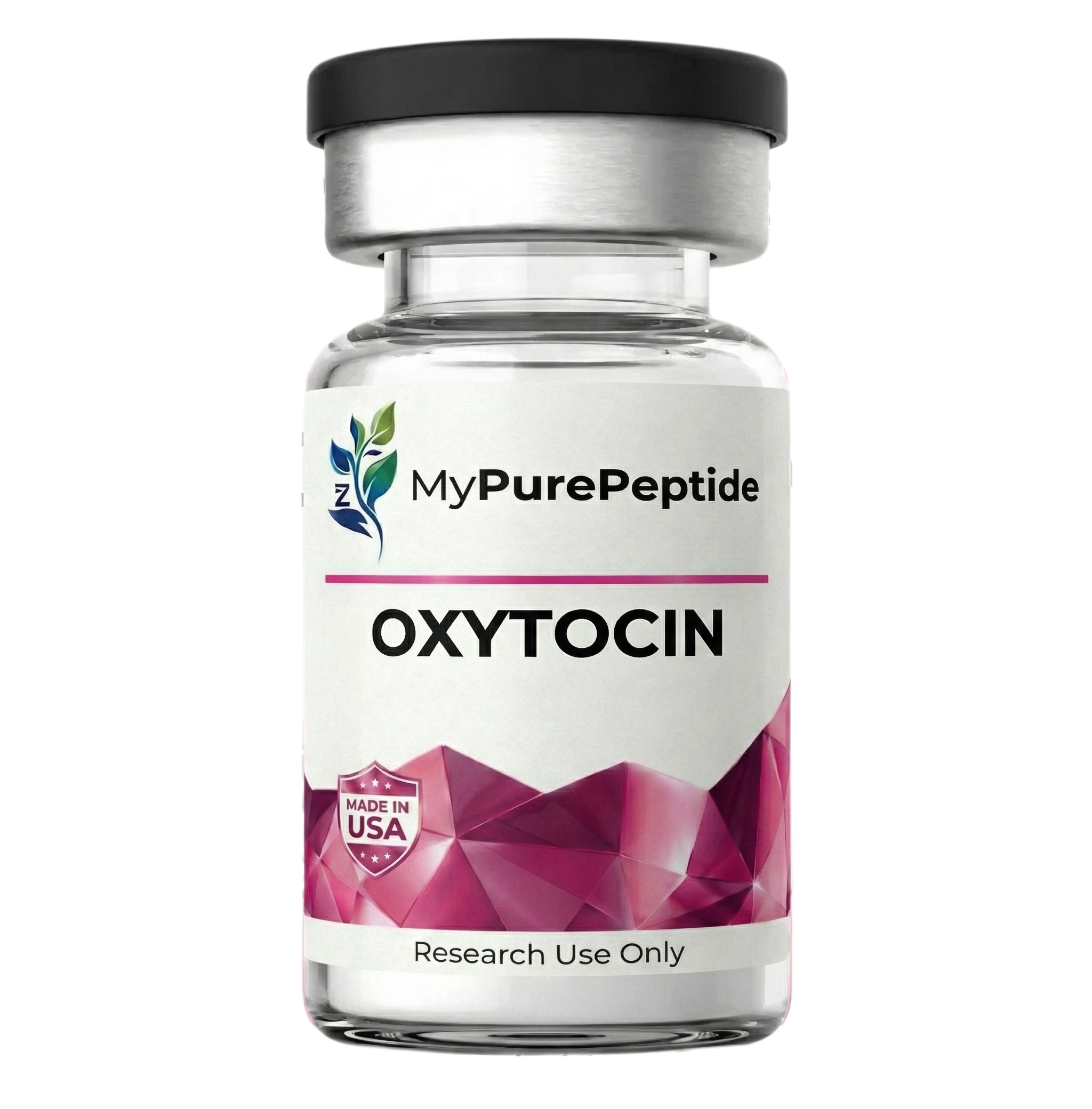
- Oxytocin (Cys-Tyr-Ile-Gln-Asn-Cys-Pro-Leu-Gly-NH2, disulfide bridge Cys1-Cys6)
- Chemical form
- Exact salt/counterion: use the current lot COA as the controlling source
- Physical form
- Lyophilized powder
- Amount
- 10mg per vial
- Storage
- Unopened vial: store sealed, dry, and protected from light at controlled room temperature or refrigerated. After opening or reconstitution: keep refrigerated at 2–8 °C.
Oxytocin is a nine-residue cyclic peptide containing an intramolecular disulfide bridge between the cysteine residues at positions 1 and 6, producing a six-residue ring with a three-residue C- terminally amidated tail. It differs from vasopressin at two positions only, carrying isoleucine at position 3 and leucine at position 8 where vasopressin carries phenylalanine and arginine. Both belong to the same nonapeptide structural family.
The primary molecular target is the oxytocin receptor (OXTR), a class A G-protein-coupled receptor, with measurable cross-affinity for the vasopressin receptor subtypes V1a, V1b and V2. Affinity is determined in recombinant membranes expressing each subtype individually by competition displacement of a labelled reference ligand. Gq coupling is quantified in transfected cell lines by inositol monophosphate accumulation and intracellular calcium mobilisation. Cross-subtype selectivity ratios are calculated only from assays run under matched conditions on the same platform.
- 01
Competition binding and displacement assays across OXTR and V1a/V1b/V2 recombinant membrane panels
- 02
Inositol monophosphate accumulation and calcium mobilisation assays in transfected cell lines
- 03
Beta-arrestin recruitment and receptor internalisation assays
- 04
Reference standard for HPLC and LC-MS method development and system suitability testing
- 05
Disulfide-bridge integrity and reduction/oxidation monitoring by LC-MS
- 06
Peptide stability and solubility characterisation under defined buffer and temperature conditions
Primary literature on nonapeptide disulfide chemistry, the synthesis of oxytocin, and oxytocin/vasopressin receptor binding and second-messenger assay methodology is indexed in PubMed, with identity records in PubChem and ChEMBL. Search results and cited literature do not establish the performance of a commercial lot or a use recommendation.
It is supplied for laboratory research and analytical work only and is not intended for human or veterinary use.
Each lot is tied to a laboratory report reference, and that report controls the purity and content figures for the material shipped rather than any fixed percentage published on the website.
The oxidised cyclic peptide and the reduced linear form differ by 2 Da and resolve as separate HPLC peaks, so LC-MS mass confirmation on the COA establishes which species is present.